Report: Over 10,000 Sports IP Owners Generated $174 Billion in Revenue Last Year
Sports marketing agency Two Circles recently released the 2026 Sports IP Revenue League report.
The report lists the 50 sports IPs with the greatest revenue growth potential globally in 2025 and provides an in-depth analysis of how and where the overall growth of the sports economy is being achieved.
The report notes that in 2025, over 200 different sports and more than 10,000 sports IP owners generated $174 billion in revenue, setting a new record and continuing the growth momentum of the past decade.
Since 2015, the compound annual growth rate of sports IP revenue has reached 6%, nearly double the global economic growth rate over the same period. This is not a cyclical upturn but structural growth.
The report estimates that by 2033, the sports IP market will exceed $260 billion.
Below is the report interpretation by Orange Bay Sports.
*Text in the screenshot translated by Google Translate
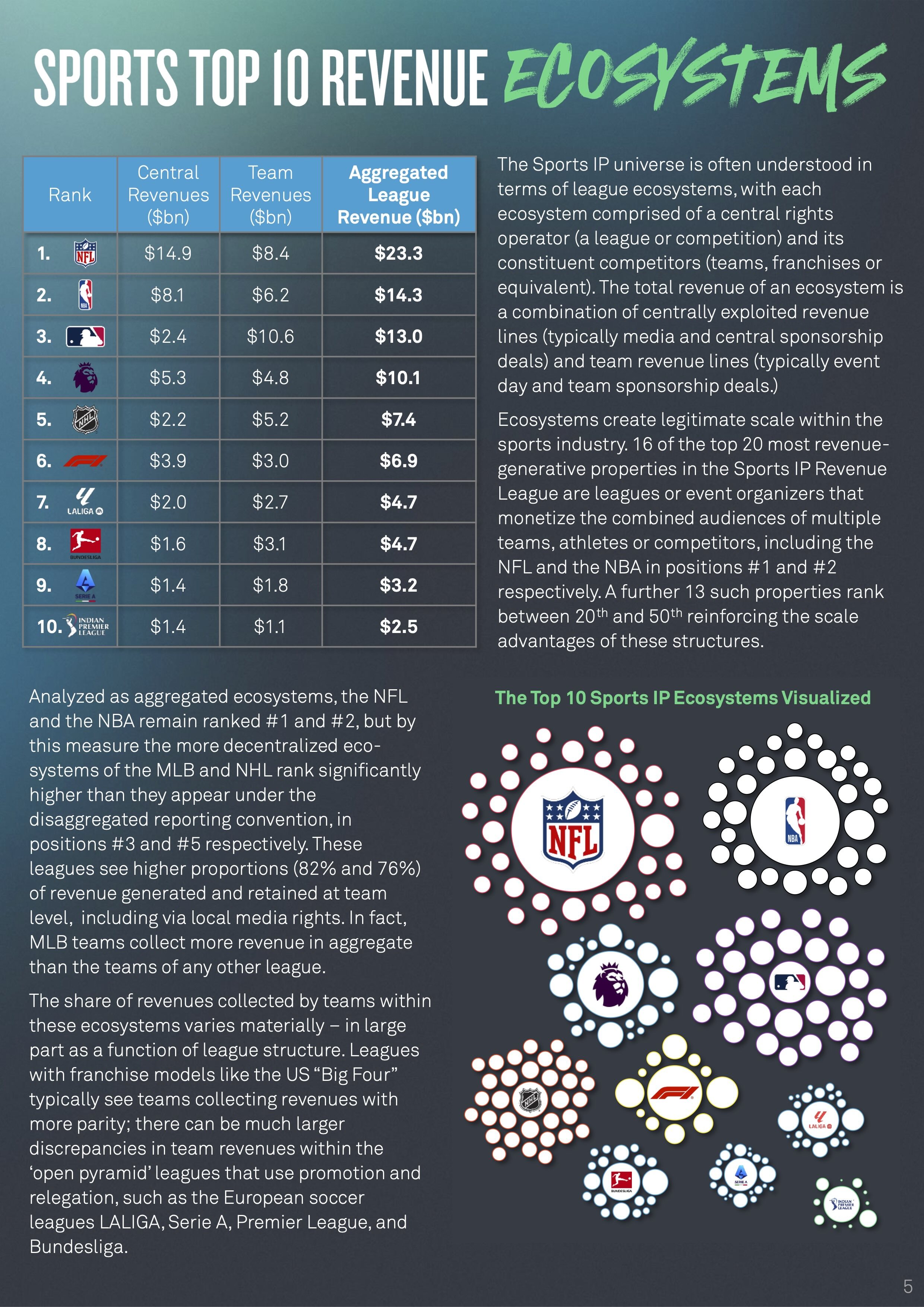
1.Ecosystems create true scale in the sports industry
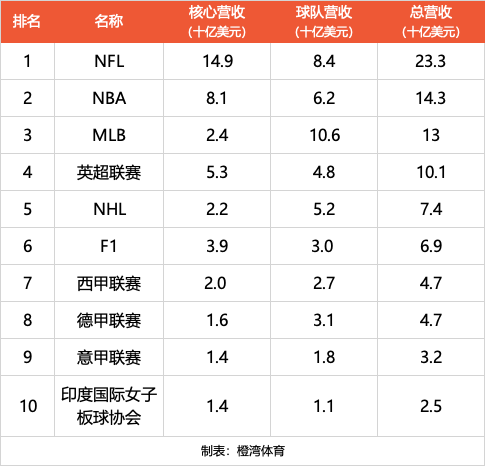
*In the table below, core revenue refers to revenue from media and core sponsorship agreements, team revenue refers to revenue from matchday and team sponsorship agreements, and total revenue is the sum of the two.
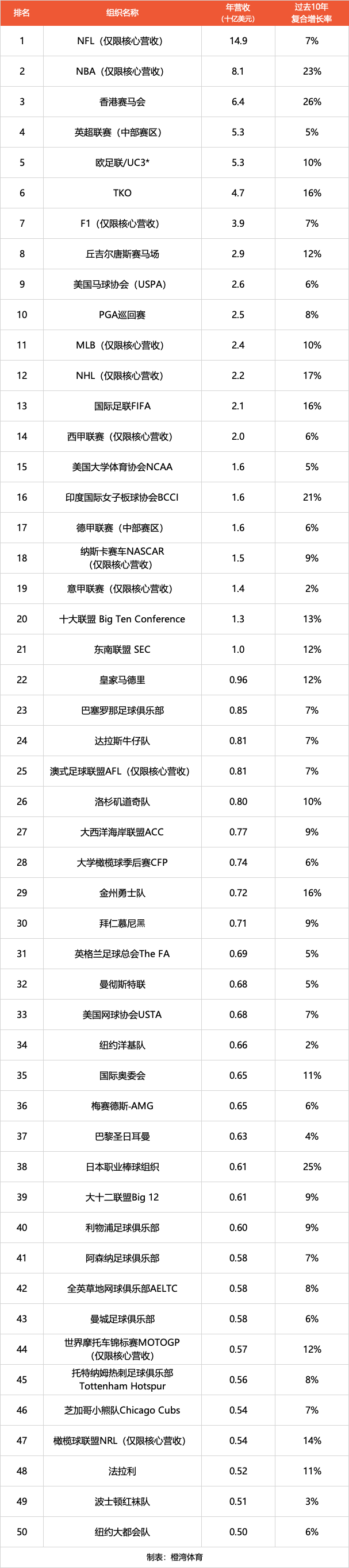
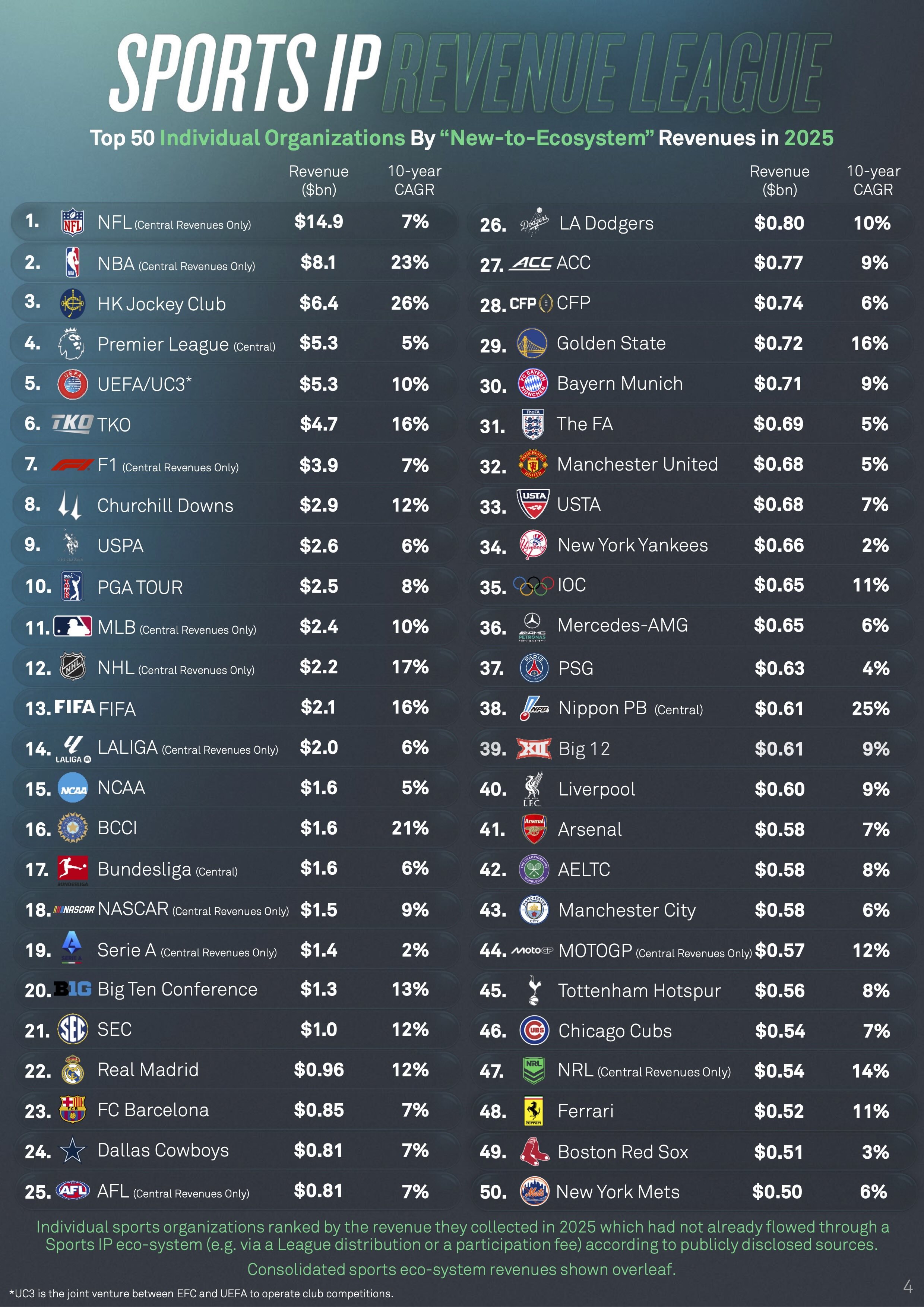
Below are the top 50 independent organizations by revenue in 2025:
Below are the top 10 sports ecosystems by revenue:
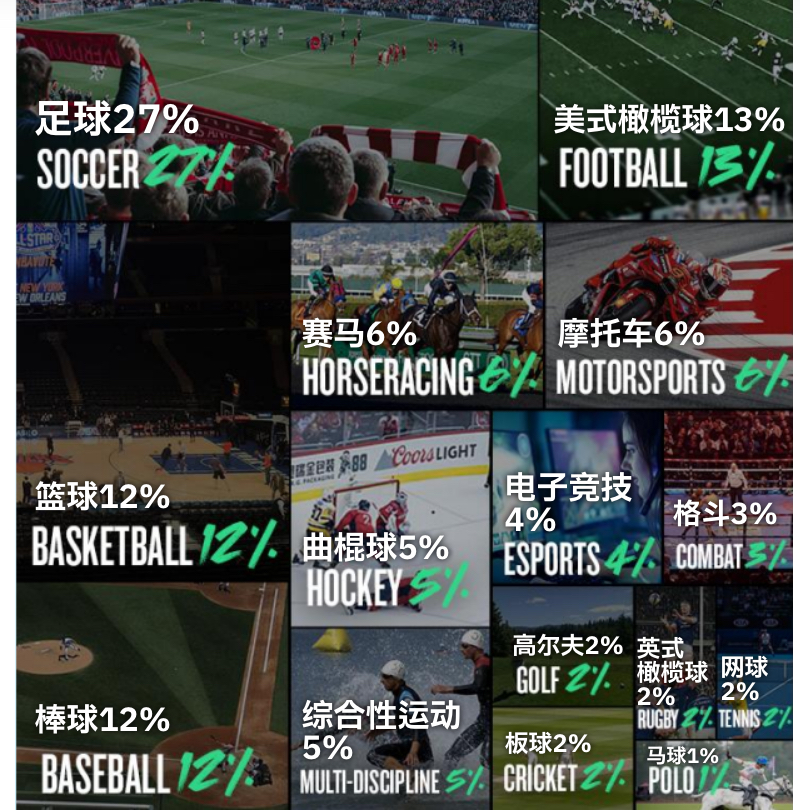
2. Football accounts for 27% of sports IP revenue
By sport, the share of sports IP revenue is as follows: Football 27%; American football 13%; Basketball 12%; Baseball 12%; Horse racing 6%; Motorcycle racing 6%; Ice hockey 5%; Multi-sport events 5%; Esports 4%; Combat sports 3%; Golf 2%; Rugby union 2%; Tennis 2%; Cricket 2%; Polo 1%.
Football's dominance stems from its massive scale, year-round schedule, and unparalleled global influence. No other sport has such a large and geographically diverse fan base, with domestic leagues, continental competitions, and international tournaments held throughout the year.
Despite football's dominance, the revenue composition within the IP ecosystem reflects some enduring truths about fan preferences in sports.
Team ball sports still account for the vast majority of sports revenue (70%) and remain the focus of modern sports fans.
Racing sports account for 13% of market revenue, while individual ball sports, combat sports, and other categories (multi-discipline organizations, esports, etc.) make up the rest of the market.
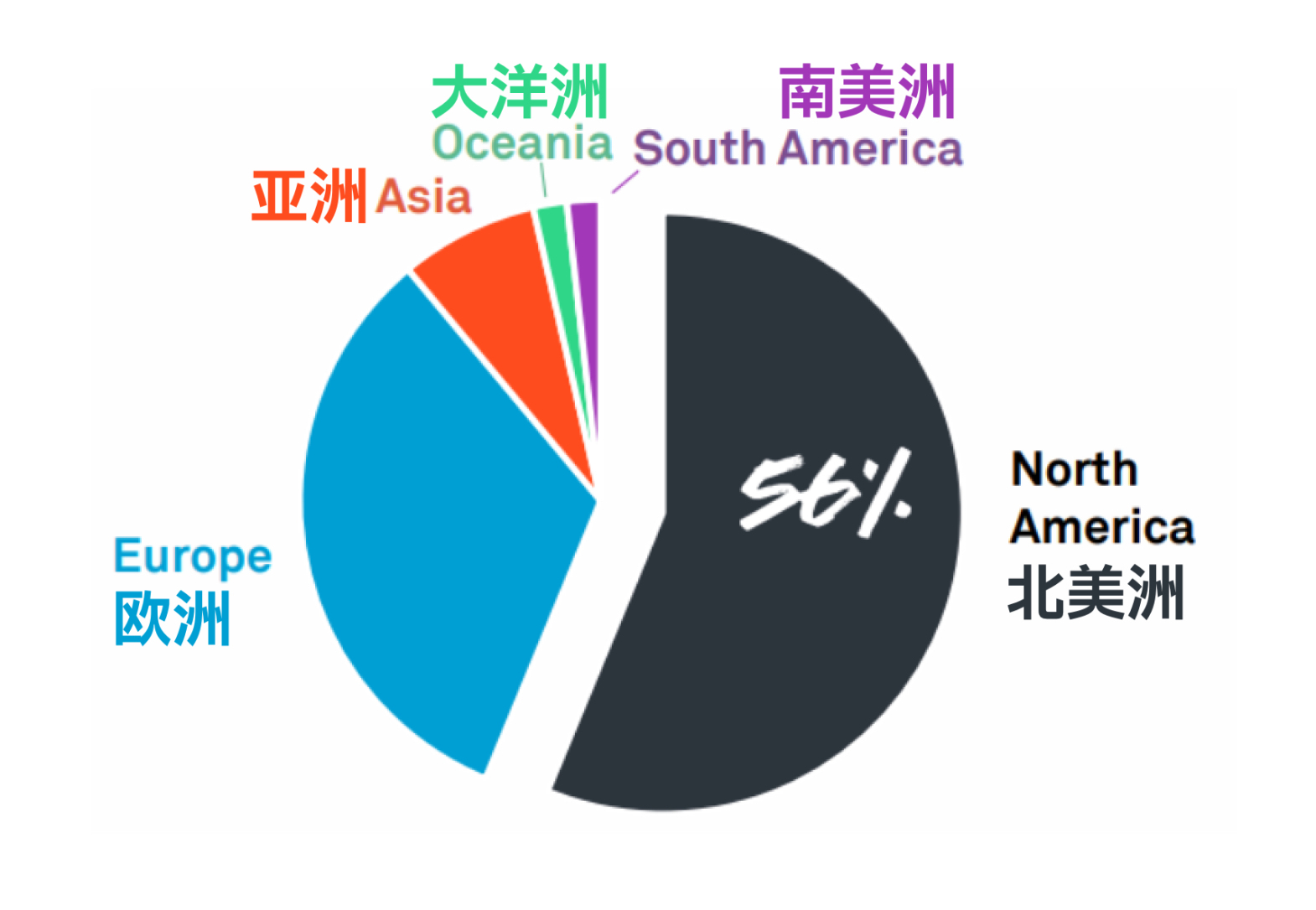
3. The U.S. is the world's largest sports market
The United States is by far the world's largest sports market. Sports events headquartered, operated, and/or primarily broadcast in the U.S. now contribute more than half of global sports IP owner revenue.
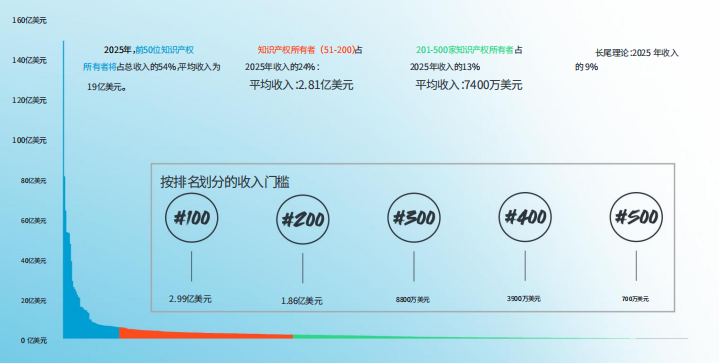
4. The strong get stronger
Scale remains an undeniable competitive advantage for sports IP owners, as evidenced by the continued consolidation of the largest sports IP owners at the top of the ecosystem. The top 10 IP owners will capture 34% of industry revenue in 2025, up from 30% in 2015; the top 20 IP owners' share of industry revenue will also grow from 39% in 2015 to 42% in 2025.
Major leagues, events, and governing bodies benefit from a virtuous cycle: stronger cultural influence leads to a broader audience, which drives higher revenue, which in turn can be used to fund further growth through better products and experiences and wider distribution channels. This is reflected in growth rates: the top 20 leagues, events, and governing bodies grow at 12% annually, about twice the market average of 6%.
The result is increasing market concentration. 286 sports organizations with annual revenues exceeding $100 million account for more than 95% of industry revenue.
5. Among the top 50, the biggest year-over-year gainers are the NBA, FIFA, and TKO
The top 50 teams and franchise brands share some clear commonalities:
They are all in highly globalized, mature sports ecosystems (football, basketball, baseball, and American football). They are all long-established brands that can generate substantial revenue independent of on-field performance, possess strong historical brand equity, and have diversified business models that convert audiences into international or even global revenue streams. These characteristics support their continued growth and market-leading revenue levels.
Among the top 50, the biggest year-over-year gainers are the NBA, FIFA, and TKO.
The NBA's performance soared thanks to new media rights deals worth approximately $77 billion over the past 11 years. FIFA has benefited significantly from the revamped FIFA Club World Cup in 2025, while TKO's growth is mainly due to major media deals for UFC and WWE, including partnerships with Paramount and Netflix. In contrast, UEFA and the IOC saw a decline in annual revenue in 2025, driven by events like UEFA Euro 2024 and the 2024 Paris Olympics.

6. Three strategies for sports IP revenue growth
Sports IP owners outside the top 50 also demonstrate various growth potentials, primarily revolving around three strategies:
Growth Strategy 1: Accumulating attention through a global tour model
Tour events like the ATP and DP World Tour leverage their global schedules to attract regular and sustained viewership from different countries, time zones, and audience segments.
Growth Strategy 2: Creating "must-watch" events
Events like the Australian Open are typical of many annual events in the top 100 that are experiencing structural year-on-year growth. These events are exemplary in continuous product and experience innovation—expanding their offerings in ways fully aligned with their respective brands and strategically focusing on enhancing incremental revenue per fan.
Growth Strategy 3: Format and/or audience innovation
Events like Formula E and Sail GP are exemplary in this regard—they demonstrate how operators can succeed through a series of coherent innovations in their sport, broadcast presentation, and market positioning.
These innovations help these events find and attract new audiences, thereby supporting commercial growth.
7.Sports content accounts for 9% of all global content consumption
Of the $174 billion sports market, $58 billion comes from media rights—fees paid by media companies to sports IP owners in exchange for the rights to distribute and commercialize sports content.
Today, sports content accounts for 9% of all global content consumption, up from less than 6% in 2020. The challenge for IP holders is to better adapt to this change and innovate their rights packages in the new era of sports IP consumption.
The NBA's latest domestic rights deal, expected to add $4.3 billion annually starting in 2025, shows that premium content can be valued across traditional broadcasters and streaming platforms by structuring multi-partner media rights packages, thereby maximizing current revenue and preparing for the future.
8. Women's sports continue to grow rapidly
Women's sports continue to grow rapidly, reaching a commercial turning point in 2025.
The UEFA Women's Euro and the Women's Rugby World Cup, as two flagship events, fully demonstrate how growing audience demand translates into significant revenue increases.
Revenue for the UEFA Women's Euro 2025 doubled from $73 million (€63 million) in 2022 to $148 million (€128 million) in 2025, driven mainly by growth in media rights revenue and an expanded sponsorship portfolio.
The 2025 Women's Rugby World Cup significantly boosted the sport's commercial profile, with sponsorship revenue growing 330% compared to the previous edition, primarily due to strong growth in partner value driven by the event's media impact.
About Two Circles
Two Circles is a global data-driven marketing company for sports and entertainment, founded by Gareth Balch (a former middle-distance runner; the company name is said to derive from the "two circles" of his specialty, the 800 meters), headquartered in London, UK. Its core business is to help the world's top sports and entertainment organizations grow their audience size and increase revenue through in-depth fan data analysis.
| Source: Report original text
| Image source: Report original text